
The climate science is unambiguous: no current pathway reaches net-zero by 2050. Even the 1.5°C “safe” pathway is delayed until 2076. The building and construction sector is at a critical crossroads — and this new DBI report delivers the clearest roadmap yet for Australia to lead the way.
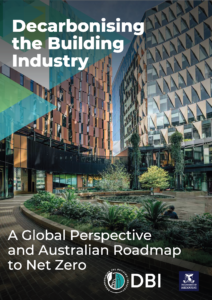
Today the Decarbonising the Building Industry (DBI) Initiative, supported by the University of Melbourne and a network of leading research and industry partners, releases Version 1.1 (April 2026) of our flagship report: Decarbonising the Building Industry – A Global Perspective and Australian Roadmap to Net Zero.
This 116-page document is the most comprehensive analysis yet of the global net-zero challenge and what it means specifically for Australia’s built environment. It combines corrected global emissions data, IPCC-aligned scenarios, and a detailed Australian sectoral roadmap.
Find out more about the Roadmap and its evolution through our Roadmap page.
The Global Reality: A Net-Zero Warning We Can’t Ignore
The report’s global analysis delivers several sobering truths:
- No policy pathway achieves net-zero by 2050.
- Even the 1.5°C pathway is delayed until 2076 (+26 years).
- Paris Agreement scenarios are 120+ years late.
- We face a critical 2030 gap of 26.9 GtCO₂e — a 49.8% reduction needed from current policies in just six years.
- The remaining 1.5°C carbon budget sits at roughly 8–10 years at today’s emission rates.
The message is clear: the window for incremental change has closed. We need emergency-scale mobilisation starting now.
Why the Building Industry Is at the Centre of the Solution
Buildings and construction are both part of the problem and the greatest opportunity.
- Operational emissions are falling thanks to renewables and electrification, but embodied carbon (from materials and construction) is rising fast.
- By 2050, embodied and operational carbon are projected to split roughly 50/50 in the building sector — and embodied carbon will dominate the built environment thereafter.
- The report sets two ambitious targets: 65% reduction in embodied carbon by 2030 and net-zero embodied carbon by 2040.
Australia’s Roadmap: Progress Made, Acceleration Required
Australia has achieved real reductions — national GHG emissions are down 27.6% since 2005 and per-capita emissions have fallen 45.6%. Electricity and land-use sectors are now performing strongly.
Yet the built environment is moving in the wrong direction: emissions in this sector have risen 41.6% since 2005, making it one of our most challenging areas.
The report’s Australian-specific roadmap provides:
- Sectoral transformation pathways for cement, steel, buildings, and infrastructure
- Investment estimates ($80–160 billion needed for the built environment alone)
- Policy, technology, and innovation priorities
- A phased 2024–2040 action plan that aligns with Australia’s updated 2035 target (62–70% below 2005 levels)
This is not just a report — it is a call to arms for everyone in the building value chain: architects, engineers, developers, material manufacturers, policymakers, and investors.
Download the full report here
Find out more about the Roadmap through our Roadmap page.
Share it with your team and network.
Join the DBI network to turn analysis into action: dbi-network@unimelb.edu.au
The science is in. The roadmap exists. The only question left is whether the building industry will lead — or be left behind.
Version: 1.1 (April 2026)
Authors: Professor Tuan Ngo, A/Prof. Behzad Rismanchi, Dr. Abdullah Anwar, Dr. Steven Linforth, and Nghia Tran, with contributions from DBI partners.