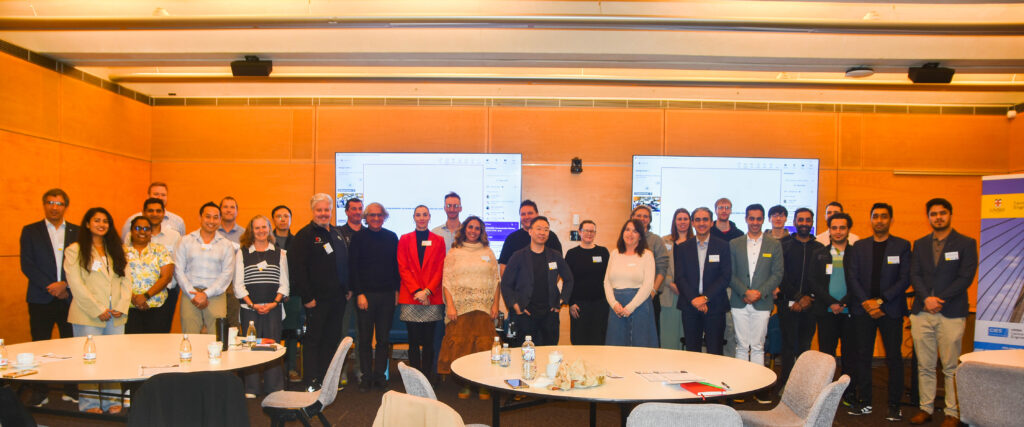
The 16 June 2026 symposium Decarbonisation Pathways using Modern Methods of Construction, hosted by UNSW’s Construction Automation Lab and the DBI Network, featured rich insights from leading voices in research, industry, and policy. A/Prof. Ali Kashani opened the event by posing a central question: Does Modern Methods of Construction automatically reduce carbon emissions? He framed the day’s discussions around embodied carbon, operational carbon, transport, and manufacturing impacts, setting the stage for nuanced exploration rather than simple assumptions.
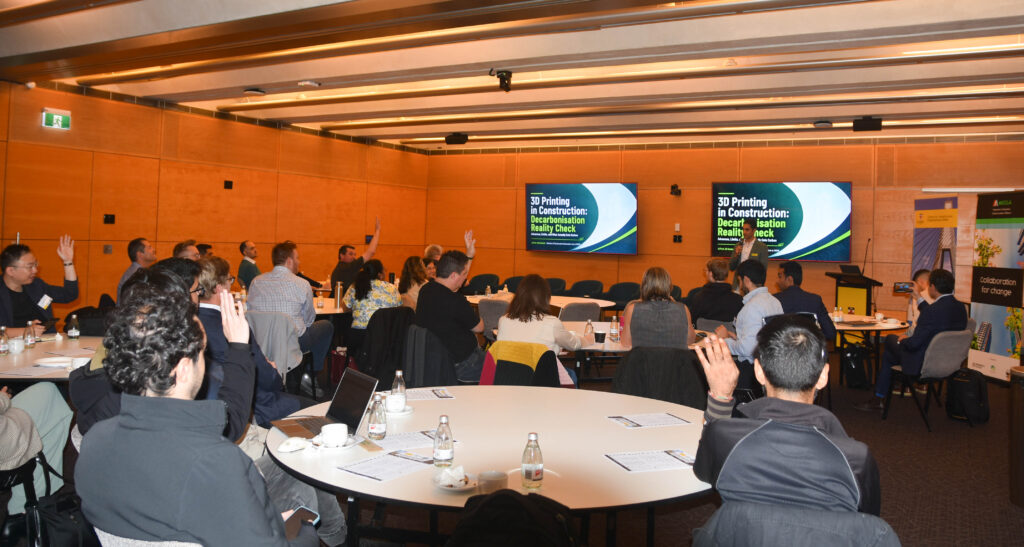
Decarbonising the Building Sector: Challenges and Opportunities
Associate Professor Behzad Rismanchi, Director of the DBI Network, provided a comprehensive overview of Australia’s decarbonisation challenges and the DBI’s role in driving collaboration. He highlighted the network’s roadmap, demonstration projects, international partnerships, and the urgent need for accelerated action to meet 2030 and 2050 targets. Rismanchi emphasised that while progress has been made, a significant ramp-up in renewables, energy efficiency, low-carbon materials, and cross-sector collaboration is essential.
Airspace Development Using MMC: The Hidden Asset for Decarbonisation and Affordability
Dr Ehsan Noroozinejad explored rooftop housing (airspace development) as a dual solution to housing shortages and carbon reduction. By adding storeys atop existing buildings with modular methods, projects can avoid substantial embodied carbon—up to 70% in some cases—while delivering faster, more affordable housing. He outlined international models, policy barriers in Australia, engineering considerations, and the potential for hundreds of thousands of new homes with minimal new land use and infrastructure demands.
Building Modularity as Systems of Systems – Robert Bird Group’s Modular Structural System, Autobox
CJ Wilson challenged conventional circular economy thinking by advocating for the reuse of building assemblies rather than just whole buildings or individual materials. He introduced Robert Bird Group’s AutoBox modular structural system, designed for disassembly, adaptation, and reuse. This approach maximises retained embodied energy while enabling flexibility for changing building uses, offering a practical pathway to significant lifecycle carbon reductions.
System Enablers to Accelerate Adoption of Innovations in MMC
Hugh Ong from SmartCrete CRC stressed that technology alone cannot transform the industry. Drawing on projects involving low-carbon concrete, 3D printing, and standards development, he highlighted the need to align research, commercialisation, policy, procurement, education, and industry adoption. Ong shared insights on scaling innovations while addressing supply chain risks and emphasised systems-based approaches to close the gap between promising R&D and real-world implementation.
The Carbon Opportunity Hidden Between Factory and Site
Scott Hearne focused on often-overlooked “hidden” carbon from inefficient project delivery, including poor coordination, bespoke designs, fragmented supply chains, delays, and rework. He positioned industrialised construction and MMC as tools to eliminate waste through standardisation, integrated supply chains, and better planning. Hearne advocated for repeatable systems, aggregated pipelines, and lean principles to deliver greater certainty, productivity, and sustainability outcomes.
Opportunities for Decarbonisation Through Freedom of Design in Construction 3D Printing
A/Prof. Ali Kashani showcased how 3D concrete printing enables topology optimisation, material efficiency, and geometric freedom. His team’s research at UNSW has developed low-carbon printable mixes with high recycled content while advancing stay-in-place formwork, modular systems, and durability improvements. Kashani emphasised evaluating not just material carbon intensity but also volume reduction and long-term service life for genuine decarbonisation.
Lamina: Computational Design Workflow for Low-Carbon 3D Concrete Printing
Dr Zayad Motlib introduced Lamina, a sophisticated computational platform developed at Arch_Manu (UNSW) that integrates architectural design, structural optimisation, material properties, and machine constraints from the outset. By designing directly for additive manufacturing, Lamina reduces material use, improves printability, and optimises for carbon savings. Motlib highlighted how computational tools can make architecture a key mechanism for decarbonisation.
Building Collaborative Capacity to Drive MMC Adoption
Professor Zelinna Pablo argued that technical innovation is insufficient without strong organisational collaboration. Drawing on ARC-funded research, she presented “collaborative capacity” as a measurable capability encompassing leadership, trust, communication, change management, and systems thinking. Through simulation-based training, these competencies can be deliberately developed to improve MMC implementation and overcome industry fragmentation.
Jumping Sectors: The Industrial Transition of Buildings
Joan Ko shared national research on least-cost pathways to net-zero housing, expanding beyond traditional building regulations to consider renewables, electrification, embodied carbon, and lifecycle emissions. She explored how MMC can help “jump sectors” by enabling industrial-scale manufacturing, economies of scale, and cross-sector integration (energy, transport, resources). Ko stressed the need for updated policy, standards, and collaborative frameworks to accelerate the transition.
Across the presentations, several powerful themes emerged: MMC is not an automatic decarbonisation solution but a powerful enabler when paired with smart material choices, optimised design, efficient delivery systems, and digital tools. Recurring priorities included reducing embodied carbon through volume optimisation and reuse of assemblies, addressing hidden carbon in fragmented supply chains, leveraging computational design and 3D printing for efficiency, building collaborative organisational capacity, and integrating MMC with broader sectoral transitions in energy, housing, and manufacturing. The speakers collectively reinforced that achieving Australia’s net-zero goals demands a whole-of-system approach — combining technological innovation with policy support, industry collaboration, and systemic change to deliver scalable, affordable, and genuinely low-carbon buildings.