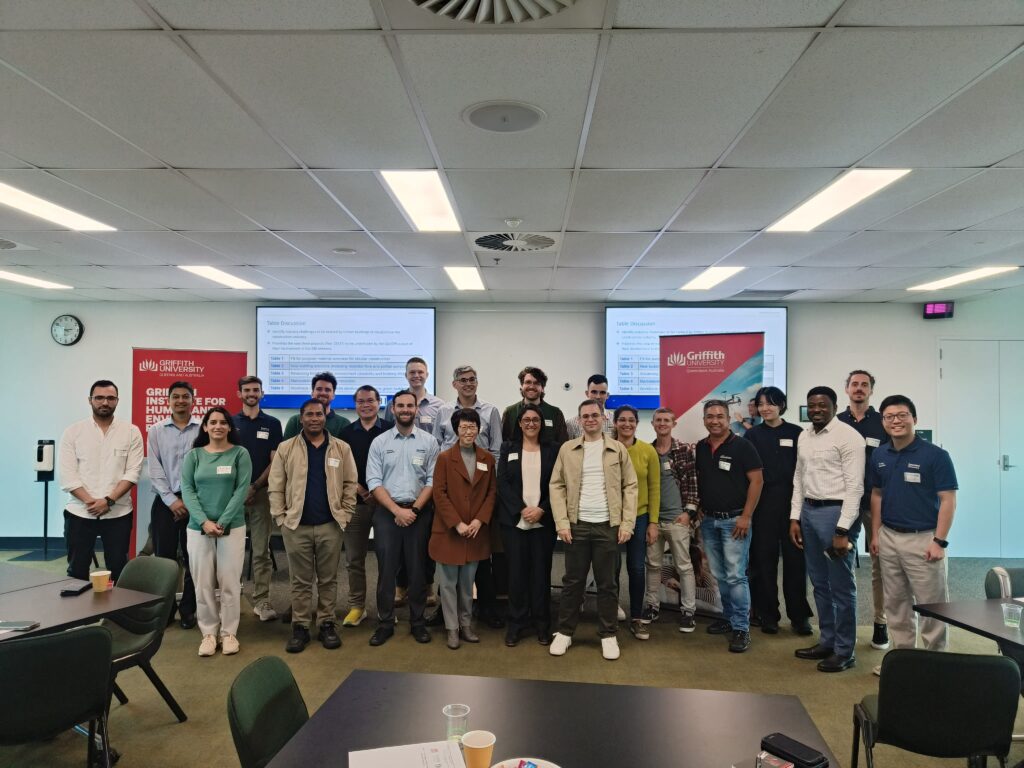
The presentations at the third DBI Workshop, held at Griffith University on 26 June 2026 in partnership with the Building Designers Association of Australia (BDAA), offered a rich mix of perspectives from government, academia, design practice, and industry. Together they explored the technical, practical, and systemic opportunities for using timber to reduce carbon emissions in the built environment.
Prof. Hong Guan and Prof. Benoit Gilbert opened the program by setting the context for the workshop. They outlined Griffith University’s strong commitment to sustainability and its leadership in timber structures research, including full-scale testing and the development of design guidelines for mass timber systems. The presentation emphasised that meaningful progress on decarbonisation requires close collaboration between academia, industry, and government, and positioned the workshop series as a step toward building a coordinated roadmap from forest resources through to building applications.
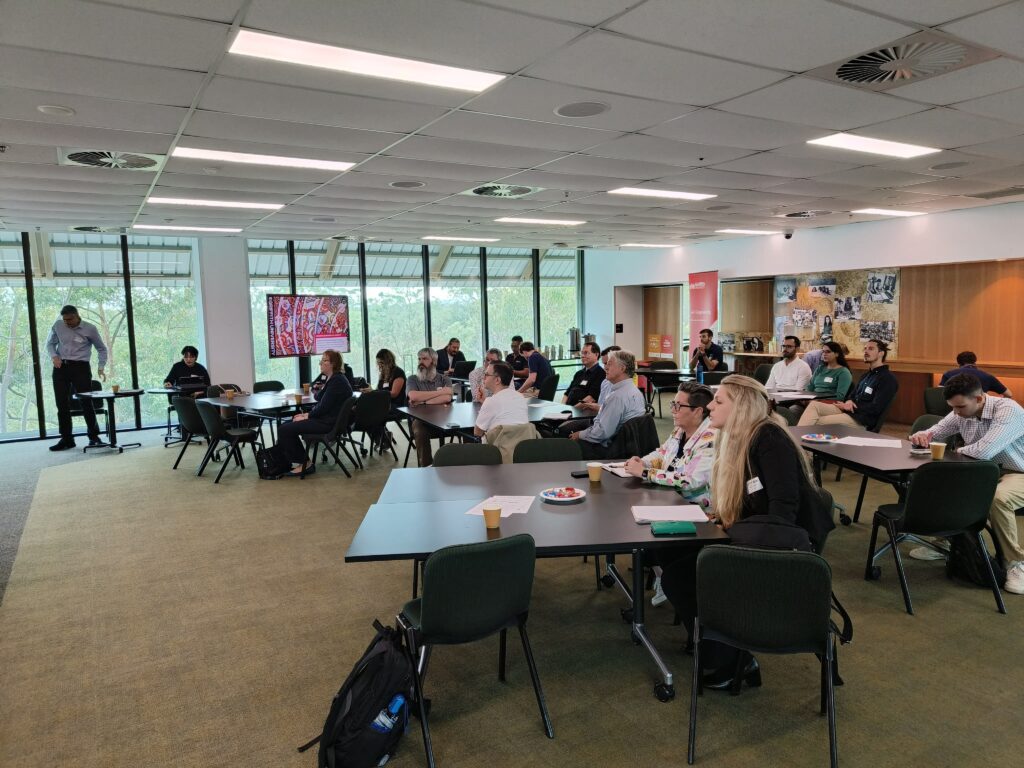
The DBI Network: Driving Coordinated Decarbonisation Across Australia
A/Prof Behzad Rismanchi introduced the DBI Network and its role in accelerating the transition to a low-carbon built environment. He described the network as a rapidly growing national initiative that brings together stakeholders from industry, government, and academia to address decarbonisation challenges in a coordinated way. The presentation highlighted significant progress already achieved through workshops, conferences, and international partnerships, while stressing that accelerated action and continued knowledge sharing across sectors are essential to meet national emissions targets.
Mind the Gap: Design Intent vs As-Built Performance
Chris Knierim delivered the first of two presentations, focusing on industry challenges related to compliance, material selection, and the critical gap between design intent and actual as-built performance. He argued that this disconnect, often caused by material substitutions and inadequate verification, undermines both building performance and decarbonisation efforts. Key messages included the need for improved quality assurance, stronger compliance verification processes, national regulatory consistency, and greater industry education to achieve reliable decarbonisation outcomes in practice.
From Waste to Resource: Timber Recycling and Circular Pathways
Clement Chan summarised outcomes from DBI-funded projects on timber resource efficiency, waste utilisation, and carbon accounting. His presentation showed that partial substitution of virgin particles with recycled softwood or hardwood in particleboard manufacturing is technically feasible without compromising performance, while full substitution reduces mechanical properties. He also highlighted carbon benefits from recycling processes and noted that while consumers value sustainability, cost and performance remain the dominant decision factors, underscoring the need for better processing efficiency and market confidence through certification.
Whole-of-System Thinking for Sustainable Construction
Prof Rebecca Gravina examined decarbonisation from a material-agnostic perspective, comparing timber and concrete systems. She emphasised that decarbonisation cannot be achieved through any single material but requires a holistic lifecycle approach that considers durability, maintenance, end-of-life scenarios, and economic drivers. The presentation showcased the promise of hybrid construction systems that combine timber with other materials to optimise structural performance while reducing carbon emissions, and stressed the importance of cross-material collaboration and system-level thinking.
Timber in Action: Retrofit and Adaptive Reuse Case Studies
Adrian Taylor demonstrated the practical application of timber in retrofit and adaptive reuse projects through compelling case studies. He showed how lightweight timber extensions and vertical additions can deliver substantial embodied carbon savings by retaining existing structures rather than demolishing and rebuilding. The presentation highlighted benefits such as faster construction timelines and reduced disruption to occupants, while also identifying regulatory constraints and limited industry familiarity with timber systems as key barriers that still need to be addressed.
Digital Platforms for Informed, Low-Carbon Material Choices
Chris Knierim returned later in the program to focus on emerging digital tools that support material selection and decarbonisation decision-making. He presented the Evitat platform as an example of how digital tools can provide rapid access to embodied carbon data, performance characteristics, and environmental ratings, enabling more informed choices at early project stages. The presentation stressed the importance of robust, verified data to avoid greenwashing and concluded that integrating reliable digital platforms into design workflows will be essential as the industry becomes increasingly data-driven.
Timber Framing: A Major Opportunity for Residential Decarbonisation
Kersten Gentle and Rhianna Robinson closed the presentations by addressing the strategic importance of timber framing in decarbonising Australia’s residential sector. They demonstrated that timber already plays a dominant role in residential construction and represents a major opportunity for carbon storage. The speakers highlighted ongoing work to develop new timber framing standards and decision-support tools for carbon accounting and material comparison, while noting that realising timber’s full decarbonisation potential will require improved data, stronger policy support, and better integration across the supply chain.
These presentations collectively painted a compelling and multi-layered picture of timber’s role in decarbonising Australia’s construction industry. From foundational research and national collaboration frameworks to material innovation, circular economy opportunities, practical retrofit solutions, and digital decision-support tools, the speakers demonstrated both the depth of current knowledge and the clear pathways still needed to scale impact. A consistent message across all talks was the critical importance of stronger integration between research, industry practice, and policy — supported by better real-world data, updated standards, verified tools, and genuine cross-sector partnerships. By bringing together voices from Griffith University, the DBI Network, BDAA, the Queensland Government, The University of Queensland, BVN Architecture, and FTMA, the session not only showcased the breadth of expertise already active in this space but also reinforced the collaborative momentum required to turn technical potential into widespread, measurable decarbonisation outcomes. The insights shared will continue to inform DBI Network activities and future content as the conversation moves from knowledge sharing into coordinated action.