
Project Summary
The Decarbonising Building Industry (DBI) Initiative is advancing sustainability by tackling the challenges of reusing treated wood waste and end-of-life engineered wood products (EWPs). This project is a collaborative effort to identify practical, Australia-specific solutions for the circular reuse of these materials, reducing landfill waste, and supporting the construction industry’s carbon reduction goals.
DBI Partner

Key Objectives:
- Low-Carbon Technology Integration: Evaluate existing low-carbon technologies for managing treated wood and EWP waste, ensuring their adaptability for Australian conditions.
- Operational Insights: Identify gaps, challenges, and opportunities to inform future demonstration projects.
- Scaling Demonstrations: Synthesise global best practices and adapt them to scale solutions in real-world Australian settings.
Project Focus Areas
- Technical and regulatory barriers to reuse.
- Economic viability and market perceptions.
- Environmental impact and lifecycle benefits.
Expected Outcomes:
This project aims to:
- Advance decarbonisation through circular economy practices.
- Promote the development of reconstituted wood products with reduced embodied carbon.
- Foster industry adoption of sustainable innovations.
Timeline and Budget:
The project will run over six months in 2025, with a total budget of $50,000. Key activities include literature reviews, industry consultations, and extension material development.

Project updates
2025 Report
Project overview:
This project explored the potential reutilisation of Australian wood waste, particularly preservative-treated and adhesive-containing materials, with a focus on technical feasibility, regulatory alignment, and industry adoption.
Project progress highlights:
This project explored the potential reutilisation of Australian wood waste, particularly preservative-treated and adhesive-containing materials, with a focus on technical feasibility, regulatory alignment, and industry adoption.
Project impact:
This project identified the major barriers for greater industry adoption and reutilisation of preservative treated wood waste, these included capital investment, the cost of landfill, technical challenges, regulatory uncertainty, fear of change, introduction of red tape, labour, supply inconsistency and uniformity, perceptions around performance, and concerns of liability.
Future work:
Further research into aesthetic enhancements, such as melamine coatings and embedding reconstituted panels into new veneer-based products, could unlock additional opportunities.
Key areas for further research include quantifying the scale of the preservative-treated wood waste problem.
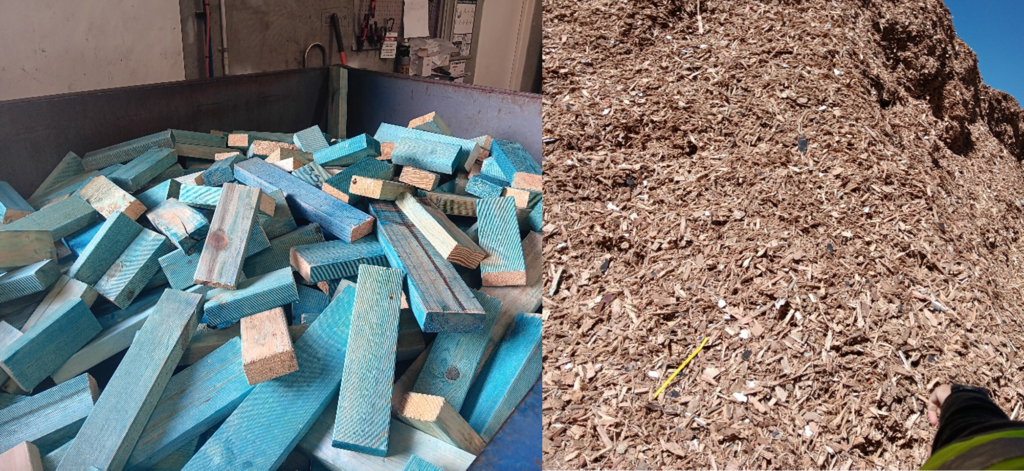
LHS – H2 treated framing offcuts (Qld), RHS – recycled material chipped for particleboard manufacture (NSW) – images by Rhianna Robinson
For inquiries, please contact:
- Adam Faircloth (Team Leader) – adam.faircloth _at_ dpi.qld.gov.au