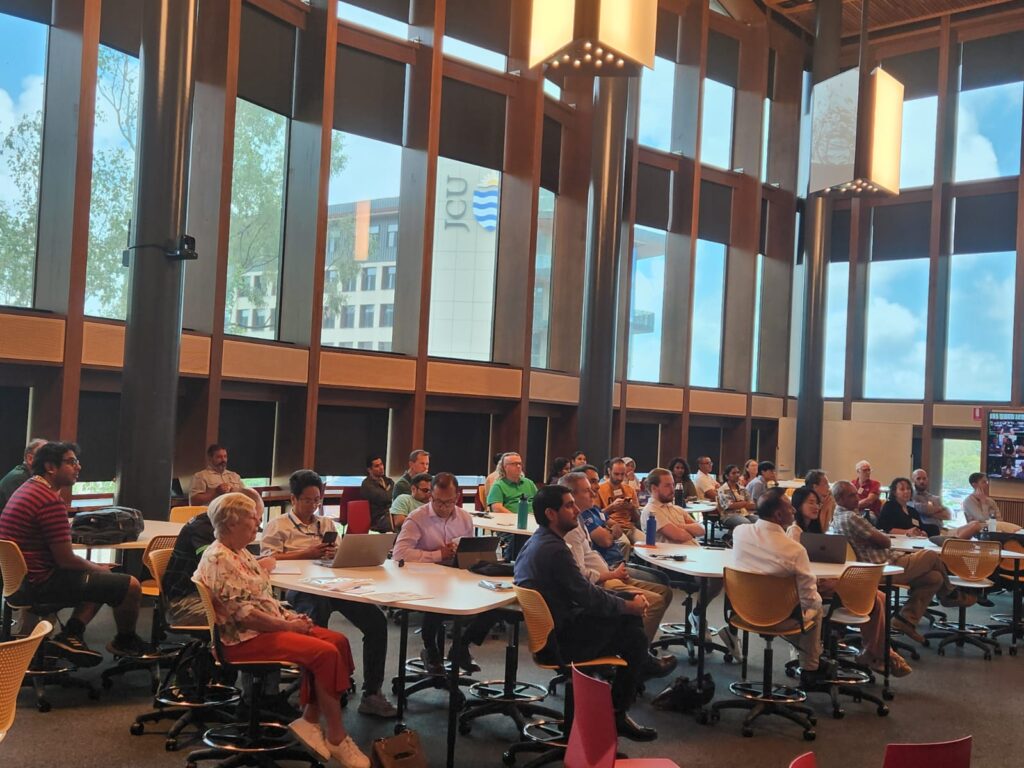
The DBI International Network Workshop – Green buildings: energy systems and sustainable materials for industry-wide decarbonisation – took place on Friday, 31 October 2025 at the Engineering & Innovation Place, James Cook University (JCU) in Townsville. This full-day event built on the success of the previous year’s gathering, drawing around 60 participants from more than 20 industries and organisations. It brought together researchers, industry practitioners, government representatives and technology providers to accelerate practical decarbonisation across construction, infrastructure and the built environment – with particular relevance to Northern Australia and tropical regions. Through keynote presentations, round-table discussions, exhibitions of innovative materials and laboratory visits, the workshop fostered collaboration, shared real-world case studies and explored scalable pathways to cut embodied and operational emissions.
Paul Roe and Mohan Jacob opened the DBI workshop by highlighting James Cook University’s broad mission in the tropics. Roe noted JCU’s focus extends beyond reefs and rainforests to include health, regional economies, indigenous futures, critical minerals, renewable energy and decarbonisation – essential for cutting emissions in construction and supporting communities. Jacob outlined Northern Australia’s challenges (climate change, geostrategic shifts, AI-driven workforce changes) and potential leadership in energy transition, emphasising JCU’s 12 research directions and the need for collaboration to drive practical outcomes in Townsville and the Indo-Pacific.
Scaling housing supply through modular prefabrication - Professor Tuan Ngo
Professor Tuan Ngo provided an overview of the DBI (Decarbonising the Building Industry) network and its mission before focusing on Australia’s housing supply crisis and the construction sector’s decarbonisation challenge. He highlighted the government’s 1.2 million homes target, the industry’s productivity lag, persistent labour shortages (especially in regional areas), material issues and slow adoption of digital and offsite methods. Drawing on Australian and international modular/prefabricated projects – including high-performance facades, multi-storey modular student apartments and high-rise structural systems – he demonstrated how offsite construction, standardisation, mass customisation, digital twins, AI and circular design can deliver faster builds, lower lifecycle costs, reduced waste and significantly lower embodied carbon. Collaboration across developers, designers, constructors, researchers and government was presented as the critical enabler for scaling these solutions.
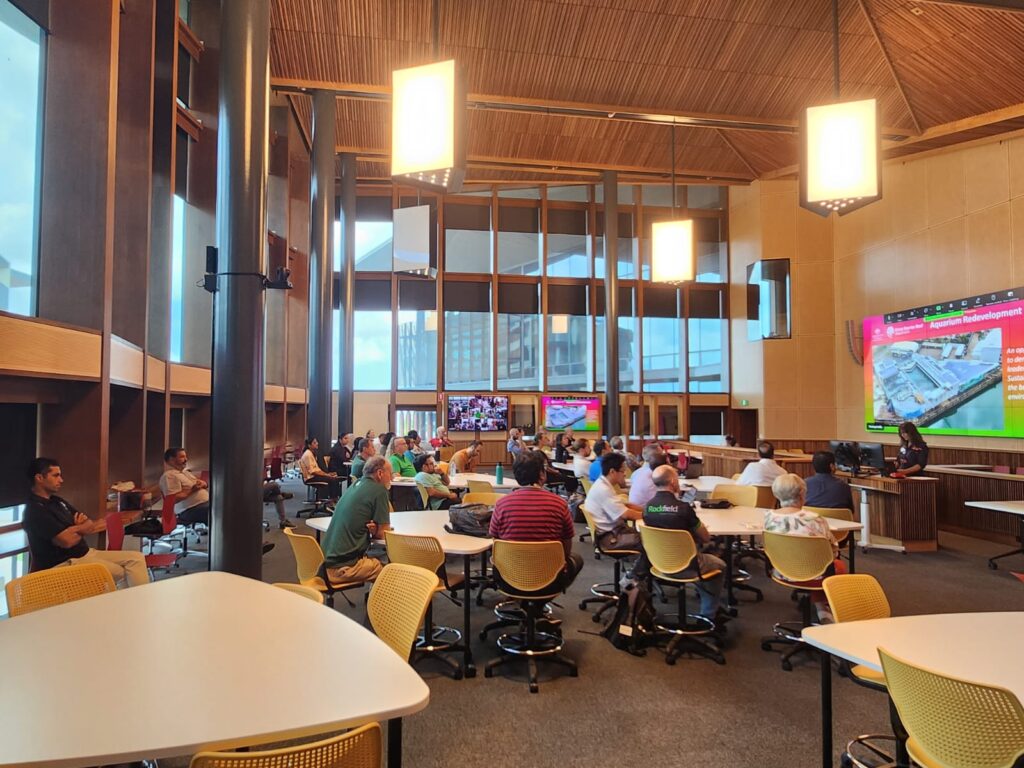
Whole-system energy efficiency at the Great Barrier Reef Aquarium - Sascha Thyer
Sascha Thyer (Great Barrier Reef Marine Park Authority) shared practical lessons from energy-efficiency and system-optimisation work at the Great Barrier Reef Aquarium – both in its existing operations and the current redevelopment project. She illustrated whole-of-system thinking by describing retrofits that halved grid electricity use, innovative pico-hydropower recovery in water filtration loops, the use of large aquarium tanks as thermal storage to shift cooling loads, and a planned shift from a high-maintenance pneumatic wave machine to efficient electric actuators. Emphasising first-principles design, mandatory Section J requirements, alignment with rating tools such as NABERS and Green Star, and careful material choices (including molten salt batteries suited to tropical marine environments), she showed how deep redesign can deliver major energy, water and maintenance savings without compromising core objectives.
Turning coffee waste into high-performance concrete - Dr Rajeev Roychand
Dr Rajeev Roychand (RMIT University) presented his team’s breakthrough work on turning organic waste – starting with spent coffee grounds – into a performance-enhancing concrete ingredient via optimised low-temperature pyrolysis. After identifying issues with raw waste, the team developed a 350°C process that produces biochar capable of replacing up to 15% of sand while increasing 28-day concrete strength by around 30% (with further gains achieved in ongoing research). Field trials demonstrated improved shrinkage resistance and the potential to reduce cement content by approximately 10%. The innovation has attracted strong industry and venture-capital interest, leading to an exclusive commercialisation agreement and expansion to other organic waste streams. The approach offers a scalable circular pathway to divert landfill waste, lower embodied emissions and improve concrete durability.
Thermal energy storage for tropical buildings - Dr Mehdi Khatamifar
Dr Mehdi Khatamifar (JCU) explored thermal energy storage – particularly ice-based and phase-change material (PCM) systems – as a tool to improve building energy efficiency in tropical climates. He outlined the growing Asia-Pacific market, Australia’s renewable integration challenges, grid stability issues and the value of shifting peak loads via time-of-use tariffs. In humid tropical conditions, where latent heat (humidity) forms a large share of cooling demand, ice thermal storage offers better humidity control than conventional air conditioning. He described JCU’s early-stage prototype using sealed aluminium cans as modular thermal cells with glycol as the heat-transfer fluid, reporting 30-45% power savings and up to 14 hours of cooling in tests. Key future work includes flow optimisation, uniform charge/discharge control, modular packaging and hybrid/cascaded designs to reach manufacturing maturity suitable for household and small-building applications.
JCU's chilled-water storage system - a long-term success story - Gregg Zonneveld
Gregg Zonneveld (JCU Estate Office) concluded the presentations with a detailed case study of JCU’s central energy plant and 12-megalitre chilled-water thermal storage system, operational since 2009. Designed to flatten peak daytime electrical demand and protect high-voltage feeders, the system charges at night (and increasingly during shoulder periods) using large chillers at high coefficient of performance (typically 7-7.5), then supplies campuses in Townsville and Cairns during the day. Despite changes in electricity tariffs, the approach continues to deliver substantial carbon savings (around 13,500 tonnes CO₂ per year initially) by avoiding low-efficiency daytime operation. He highlighted ongoing relevance, water-use challenges in evaporative cooling towers and the value of continuous monitoring and feedback from campus buildings to maintain performance.
The workshop successfully connected cutting-edge research, industry experience and regional priorities, reinforcing the power of collaboration to drive decarbonisation in construction and building operations. From modular housing and waste-derived materials to advanced thermal storage and system-level efficiency gains, the day showcased ready-to-advance solutions tailored to Northern Australia’s climate and economic context. Participants left with strengthened networks, concrete examples of low-carbon pathways and momentum for joint trials, demonstration projects and applied research partnerships that can scale impact across the region and beyond.