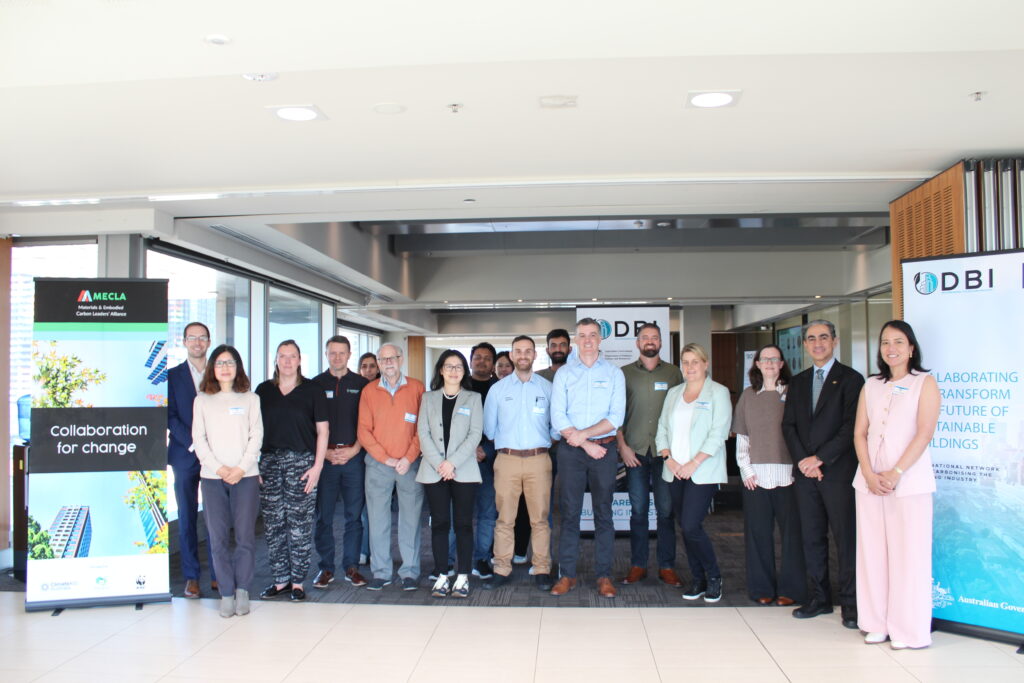
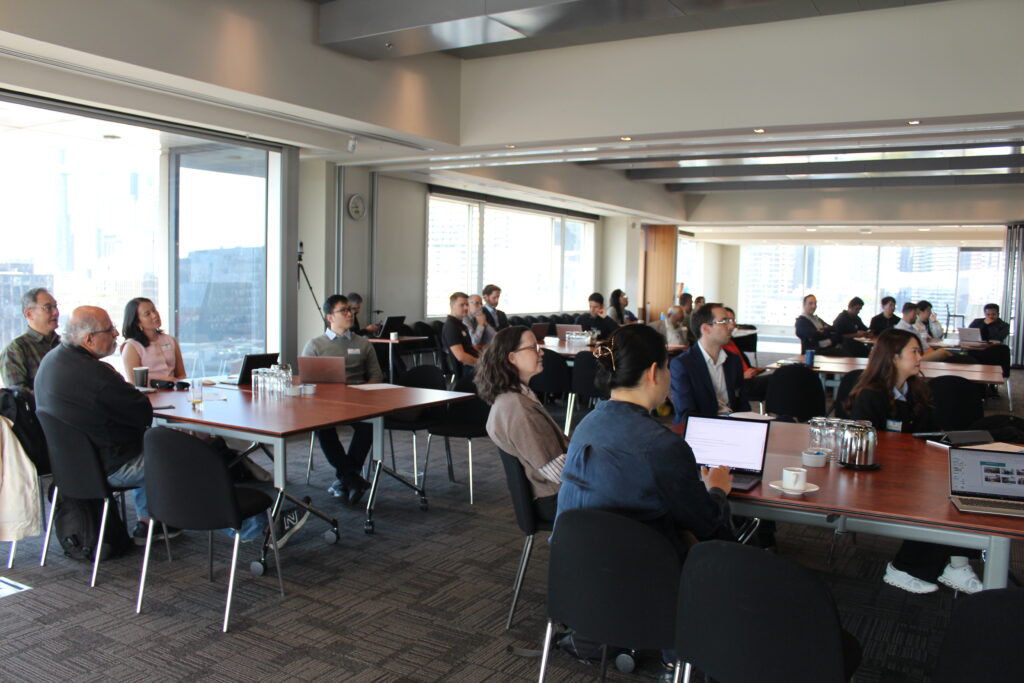
The Decarbonising the Building Industry (DBI) Network hosted a productive morning session at the University of Melbourne on 23 April 2026. Researchers and industry partners presented cutting-edge work on low-carbon materials and systems, culminating in the official launch of the DBI Roadmap to Net Zero.
Sustainable Sandwich Lightweight Flooring Systems for Modular Construction
Dr Alireza Chiniforush (University of Melbourne & M-Modular) showcased a hybrid sandwich flooring system combining CLT panels as top and bottom flanges with light-gauge steel joists. Designed for 8–12 metre spans, the system significantly improves stiffness to address deflection and vibration issues, while the bottom CLT layer provides natural fire protection through charring. The design incorporates full DfMA principles for rapid off-site fabrication and on-site assembly, demonstrating strong potential for mid-rise modular buildings.
Advancing Recycled and Reclaimed Timber Solutions
Adam Faircloth from the Department of Primary Industries (DPI) Forest Product Innovations lab in Brisbane provided an update on multiple DBI-funded timber projects. Highlights included experimental trials on particleboard made from treated and reclaimed wood waste, glulam beams produced from reprocessed reclaimed timber, and a consumer perception study revealing public openness to recycled timber — provided it performs equally and costs the same. The work emphasises both technical feasibility and the importance of addressing supply chain and perception barriers.
Ultra-Low Emission Nano-Concrete Panels for Rapid Modular Construction
Dr Abdullah Anwar (University of Melbourne & SPARK Projects) presented progress on next-generation ultra-low carbon nano concrete (ULCNC). By replacing 60–70% of cement with supplementary cementitious materials, incorporating basalt fibres and graphene oxide, and optimising mixes for vertical battery mould systems, the team has achieved over 58% embodied carbon reduction while meeting self-compacting concrete requirements and early-age strength targets essential for precast production.
Strategic Importance of Decarbonisation Research
Professor Guillermo Narsilio, Head of the Department of Infrastructure Engineering at the University of Melbourne, delivered inspiring opening remarks. He emphasised that decarbonising the built environment is a transformational challenge requiring collaboration across academia, industry, and government. He highlighted the department’s three research pillars — net zero, productivity, and future infrastructure — and praised the practical, real-world impact of the projects being presented.
Introduction of the DBI Roadmap to Net Zero (Extended version)
Dr Steven Linforth concluded the morning with the official launch of the comprehensive DBI Roadmap to Net Zero. The 100+ page report analyses global and Australian emission trends, identifies the critical 2024–2030 decade, and outlines six priority pathways and four implementation phases needed to achieve Australia’s 2030 and 2050 climate targets. It stresses the urgent need to tackle both operational and embodied carbon in the building sector.
The morning session showcased tangible, scalable solutions — from hybrid timber-steel systems and low-carbon concrete to reclaimed timber innovation — while the Roadmap launch provided a clear strategic direction for the industry. These presentations reinforced DBI’s mission to bridge research and real-world application, accelerating Australia’s transition to a net-zero built environment.