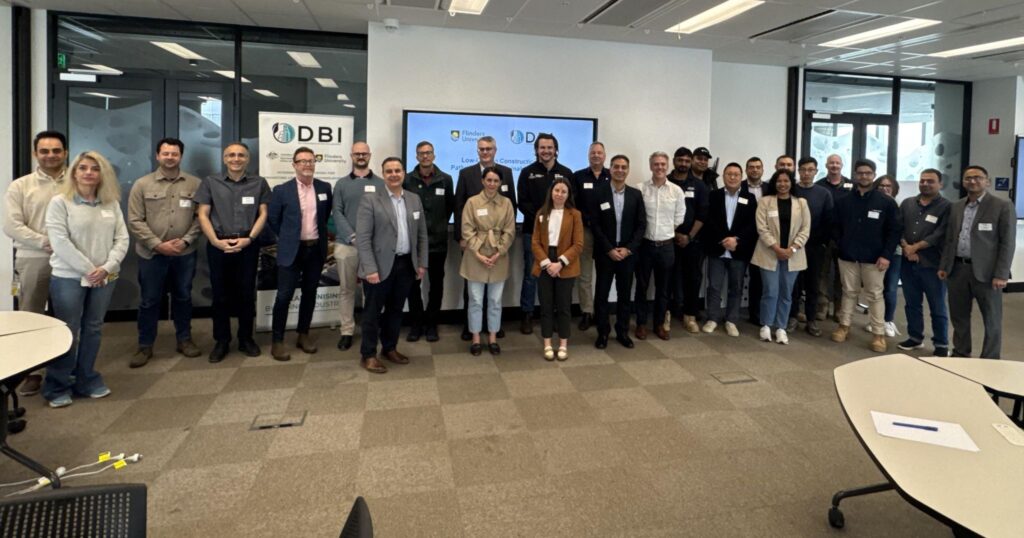
On 3 October 2025, Flinders University at Tonsley welcomed more than 80 researchers, builders, miners and recyclers for the second Australian workshop of the International Researcher Network on Decarbonising the Building Industry (DBI). With construction and building materials responsible for over a third of global emissions and more than half of Australia’s infrastructure-related emissions, the urgency is undeniable. The full-day event combined international keynotes, local industry case studies and hands-on facility tours to show that practical, scalable solutions already exist. Attendees left with new contacts, fresh ideas and a shared conviction that cross-sector collaboration is the fastest route to net-zero construction by 2050.
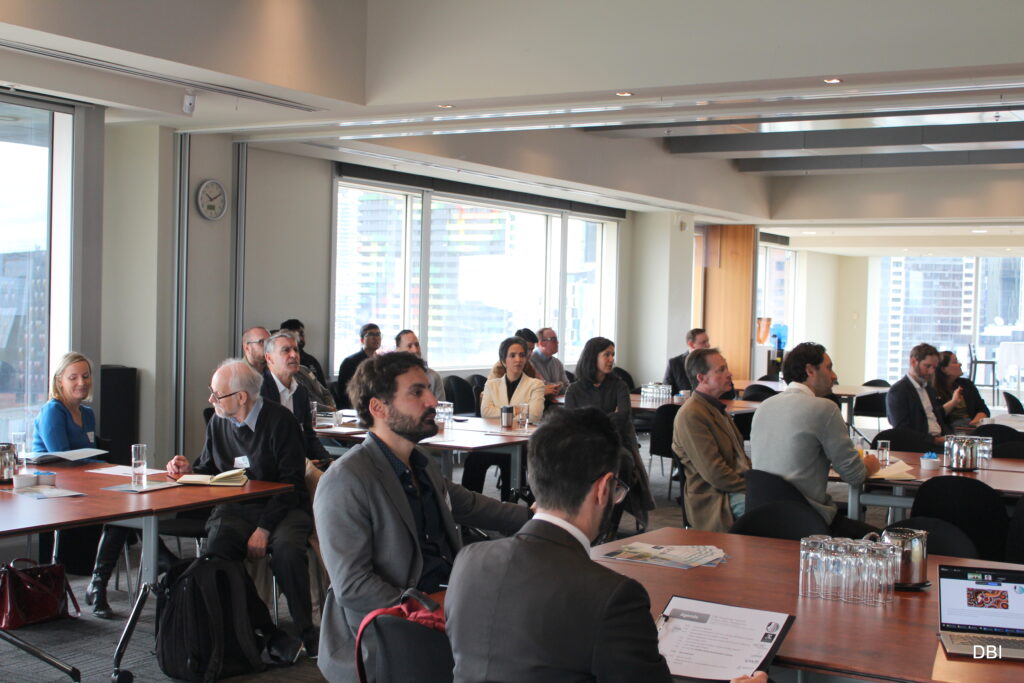
The urgent need for decarbonising decarbonising construction by 2050 - Dr Aliakbar Gholampour
Dr Aliakbar Gholampour, senior lecturer in civil and structural engineering at Flinders University and DBI steering committee member, opened the workshop by reminding everyone of the scale of the challenge. Construction accounts for 37 per cent of global emissions, with two-thirds coming from materials like cement and steel. He explained that the DBI network, funded by the Australian government, brings together universities, industry and government from Australia and overseas to create a national decarbonisation roadmap. Flinders is proud to be South Australia’s only member university in this international consortium.
Welcoming the attendees to Flinders University - Professor Alistair Rendell
Professor Alistair Rendell, Vice President and Executive Dean of the College of Science and Engineering, officially welcomed participants to Flinders and highlighted the university’s own low-carbon achievements. Since 2021 the campus has run on 100 per cent renewable electricity, extensive rooftop solar covers buildings at Tonsley, gas boilers are being replaced with heat pumps, and LED lighting with automated controls is now standard. These efforts earned Flinders top global rankings for energy and climate action two years running. Professor Rendell noted that after the upcoming Adelaide-UniSA merger, Flinders will soon become South Australia’s oldest university – and one of its greenest.
DBI initiative and its aims and programs - Professor Tuan Ngo
Professor Tuan Ngo, DBI convenor and research program leader of the $130 million Building 4.0 CRC, gave an energetic update on the network’s progress. Launched just two years ago in Melbourne, DBI now spans Australia, Asia and Europe. Upcoming milestones include the official roadmap launch on 10 November 2025, the second DBI International Conference in November 2026, and potential alignment with Australia hosting COP 31. Professor Ngo emphasised that innovation in materials, digital engineering, modular construction and artificial intelligence is essential if the building sector is to help government meet its 62-70 per cent emission reduction target by 2035.
South Korea’s strategy to carbon neutrality by 2030 - Professor Doo-Yeol Yoo
Professor Doo-Yeol Yoo from Yonsei University, South Korea, delivered a compelling keynote on cement-free strain-hardening composites. Facing strict national targets to cut building-sector emissions by 10 million tonnes by 2030, his team developed a geopolymer binder activated by calcium hydroxide recovered from seawater desalination waste. By replacing up to 60 per cent of slag cement with waste tyre crumb rubber, they achieved 8.2 per cent tensile strain, crack widths consistently below 180 µm (perfect for self-healing), and slashed embodied CO₂ by 62-67 per cent compared to traditional ultra-high-performance concrete – all while maintaining or exceeding structural performance.
Scope 3 carbon in water capital projects from tender to as built - Nicole Argent
Nicole Argent, Environment and Sustainability Manager at John Holland, presented Australia’s first construction project to achieve verified net-carbon-neutral status across Scope 1, 2 and 3 emissions. On a compact water-infrastructure job in Melbourne’s Hobsons Bay, the team built a rigorous material-tracking system despite limited resources. By combining low-carbon concrete mixes, recycled aggregates, renewable energy on site and high-quality offsets, they proved that full carbon neutrality is possible today – even on small projects – when data and determination align.
Decarbonisation of concrete and potential opportunities - Dr Weiwei Duan
Dr Weiwei Duan, lead researcher at Hallett Group, shared the South Australian concrete producer’s latest advances in low-carbon mixes. By maximising supplementary cementitious materials such as fly ash and slag, plus exploring local industrial by-products, Hallett is steadily driving embodied carbon below 200 kg CO₂ per cubic metre while meeting or exceeding strength and durability standards required by major contractors and certifiers.
The mining perspective on decarbonisation and sustainable underground construction - Dr Amin Safari
Dr Amin Safari, principal backfill engineer at Quattro Project Engineering, brought a mining perspective that resonated strongly with the audience. At the Nova nickel mine in Western Australia, his team successfully trialled a paste backfill that replaced 24 per cent of traditional binder with dried brine sludge – a lithium-refinery by-product previously destined for landfill. The new mix met all early-age and ultimate strength requirements, produced no harmful gases underground, and demonstrated that mining can turn another industry’s waste into a valuable low-carbon binder once lithium processing volumes recover.
Flinders’ facilities to run sustainable construction projects - Dr Thomas Vincent
Dr Thomas Vincent, senior lecturer in structural engineering at Flinders, showcased the university’s world-class testing facilities just metres from the lecture theatre: South Australia’s only large-scale concrete 3D printer, Australia’s largest in-situ micro-CT scanner for real-time crack imaging, a six-degree-of-freedom hexapod for seismic testing, dedicated corrosion chambers and a strong floor for full-scale structural experiments. Attendees later toured these labs and saw the equipment in action.
Research projects of the Flinders on sustainable construction materials and technologies - Dr Aliakbar Gholampour
Dr Aliakbar Gholampour closed the formal presentations by outlining Flinders’ wide-ranging sustainable construction research: recycled construction and demolition waste as aggregate, chemically treated natural fibres, low-carbon geopolymers, 3D-printed elements, glass-fibre-reinforced polymer utility poles, and seismic-resistant prefabricated systems. He invited industry to partner through student projects, matched PhD scholarships, CRC grants or direct contract research using the university’s cutting-edge facilities.
The workshop wrapped up with a lively panel discussion and lab tours that left everyone energised. From Korean geopolymers to South Australian mine backfill and Melbourne’s net-zero water project, the day proved that the technologies, facilities and willingness already exist. What remains is faster regulatory support, bolder trials and tighter collaboration. Events like this show that Australia’s construction and mining sectors are ready to lead the world toward genuine low-carbon building – one innovative cube at a time.