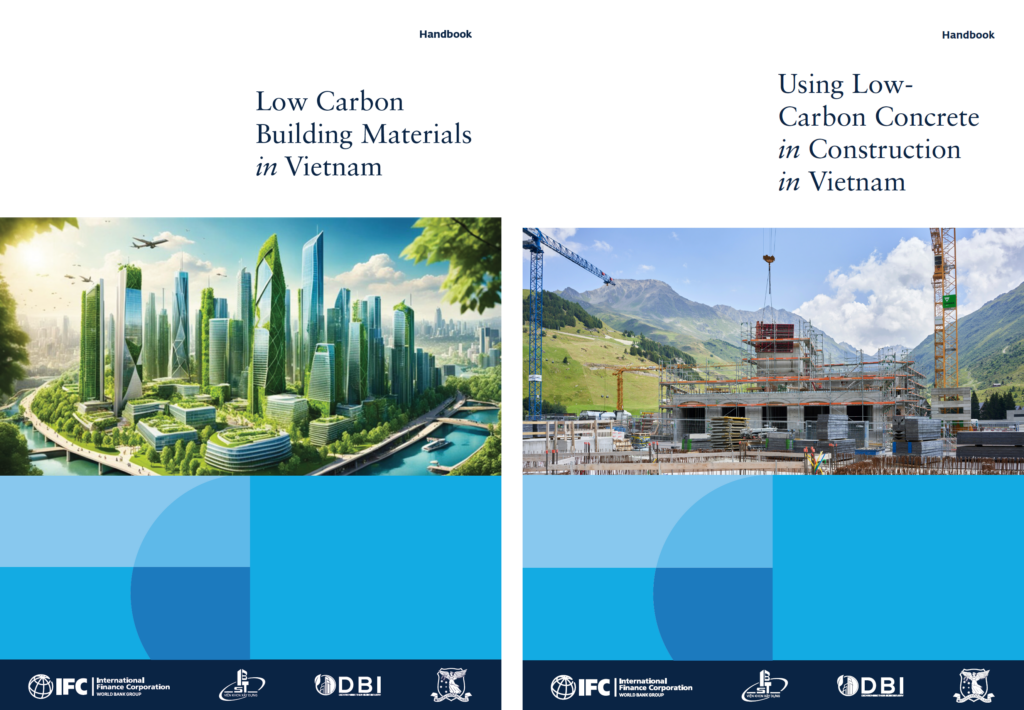
On Tuesday, 23 December 2025 (09:00–11:00am, Vietnam time / 1:00–3:00pm, Australia time), the online launch event for the technical publications supporting emissions reduction in the construction sector was successfully held via Zoom. The event was jointly organised by Vietnam Institute for Building Science and Technology (IBST), the International Finance Corporation (IFC) and Decarbonising the Building Industry (DBI), and brought together policymakers, researchers, industry representatives, design consultants, and sustainability practitioners across Vietnam.
The event marked the official release of two key technical handbooks:
- Low-Carbon Building Materials in Vietnam
- Using Low-Carbon Concrete in Construction in Vietnam
The Low-Carbon Building Materials in Vietnam handbook adopts a system-level perspective, examining embodied carbon across major material sectors including cement and concrete, steel, bricks, glass, aluminium, and bio-based materials. It synthesises national emissions data, decarbonisation technologies, policy instruments, green public procurement, and the role of Environmental Product Declarations (EPDs), providing a strategic roadmap to support market transformation and investment in low-carbon materials.
Complementing this, Using Low-Carbon Concrete in Construction in Vietnam delivers project-level, practice-oriented guidance. It demonstrates how embodied carbon reductions of 20–40% can be achieved through integrated strategies encompassing structural optimisation, performance-based specifications, mix design innovation, supply-chain engagement, and life-cycle assessment. The handbook emphasises early-stage decision-making as the most effective lever for carbon reduction while maintaining structural performance and constructability.
Throughout the event, presentations emphasised data-driven and life-cycle-based methodologies, including Life Cycle Assessment (LCA), EPDs and performance-based design. Particular focus was placed on illustrating how substantial emissions reductions can be realised through coordinated interventions across material production, structural design, concrete technology, and procurement practices without compromising technical requirements.
The technical discussion session generated strong engagement, with participants exchanging perspectives on:
- Emissions reduction potential across key building material and concrete sectors in Vietnam
- The role of standards, policy frameworks, and market mechanisms in accelerating the uptake of low-carbon solutions
- Practical pathways for implementing the handbook recommendations in real construction and infrastructure projects
This event also served as a platform for scientific dialogue and cross-sector collaboration, reinforcing a shared commitment to advancing low-carbon, resilient, and sustainable construction practices in Vietnam.